Responsible AI eLearning Module for TV & Film
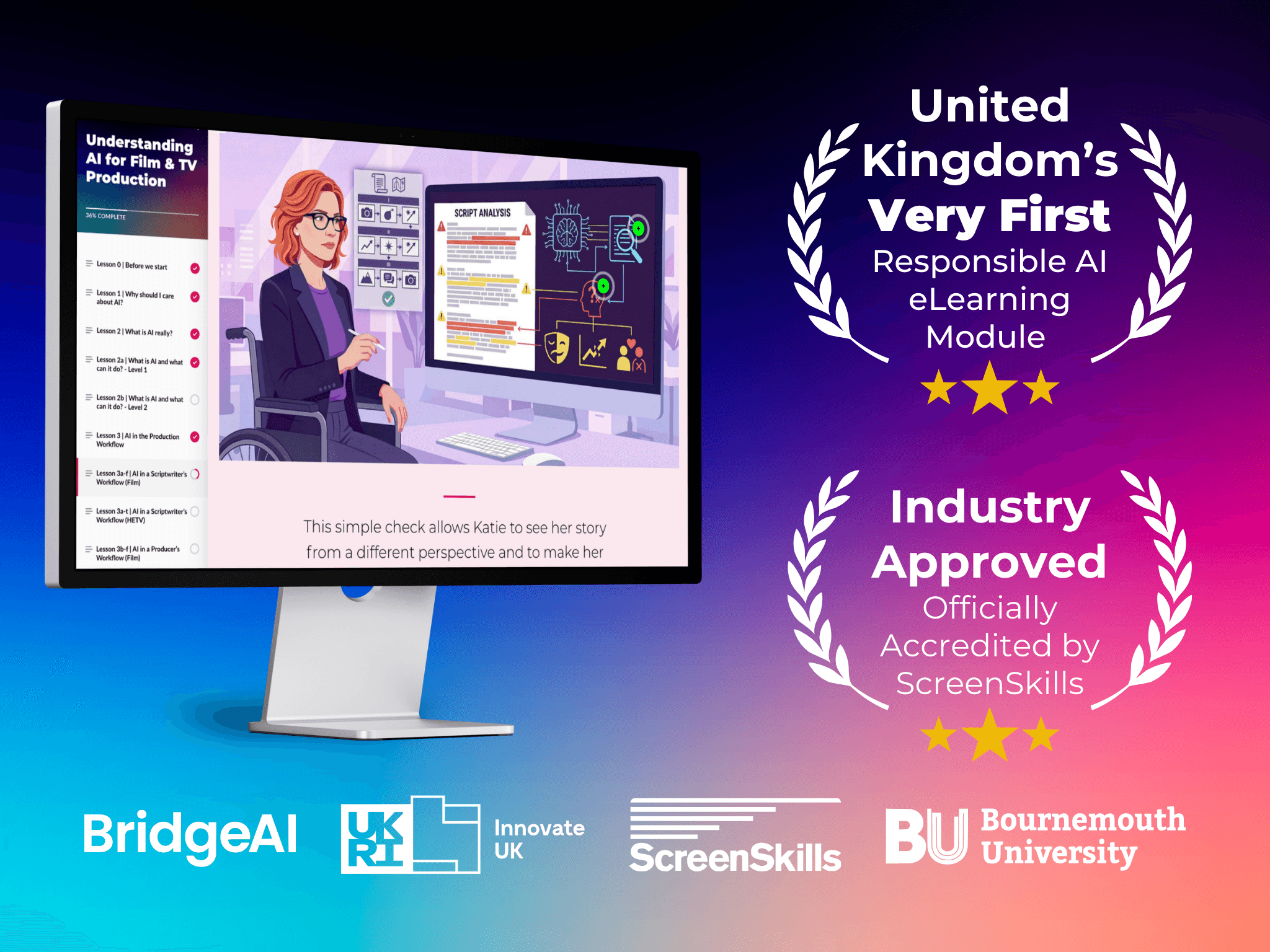
AIMICI’s "Responsible AI in Film & TV Production" eLearning module is a comprehensive educational tool designed to guide creative professionals through a wide spectrum of challenges, from ethical dilemmas to legal compliance. This module empowers participants to make informed decisions in critical areas such as copyright, performers' rights, and data privacy, while demonstrating how to safely integrate complex AI tools into production workflows through concrete case studies and simulations.
Scope
eLearning, Workforce Development
Role
AI Learning Experience Design Consultant
Client
AIMICI
Year
2025
Overview
The UK screen industries (Film, TV, VFX) a sector contributing £21 billion GVA and employing over 200,000 people faced an unprecedented disruption by early 2026. The rapid, unmanaged integration of Generative AI created a critical skills gap and a complex landscape of legal and ethical risks, particularly for a workforce comprised of 50% freelancers.
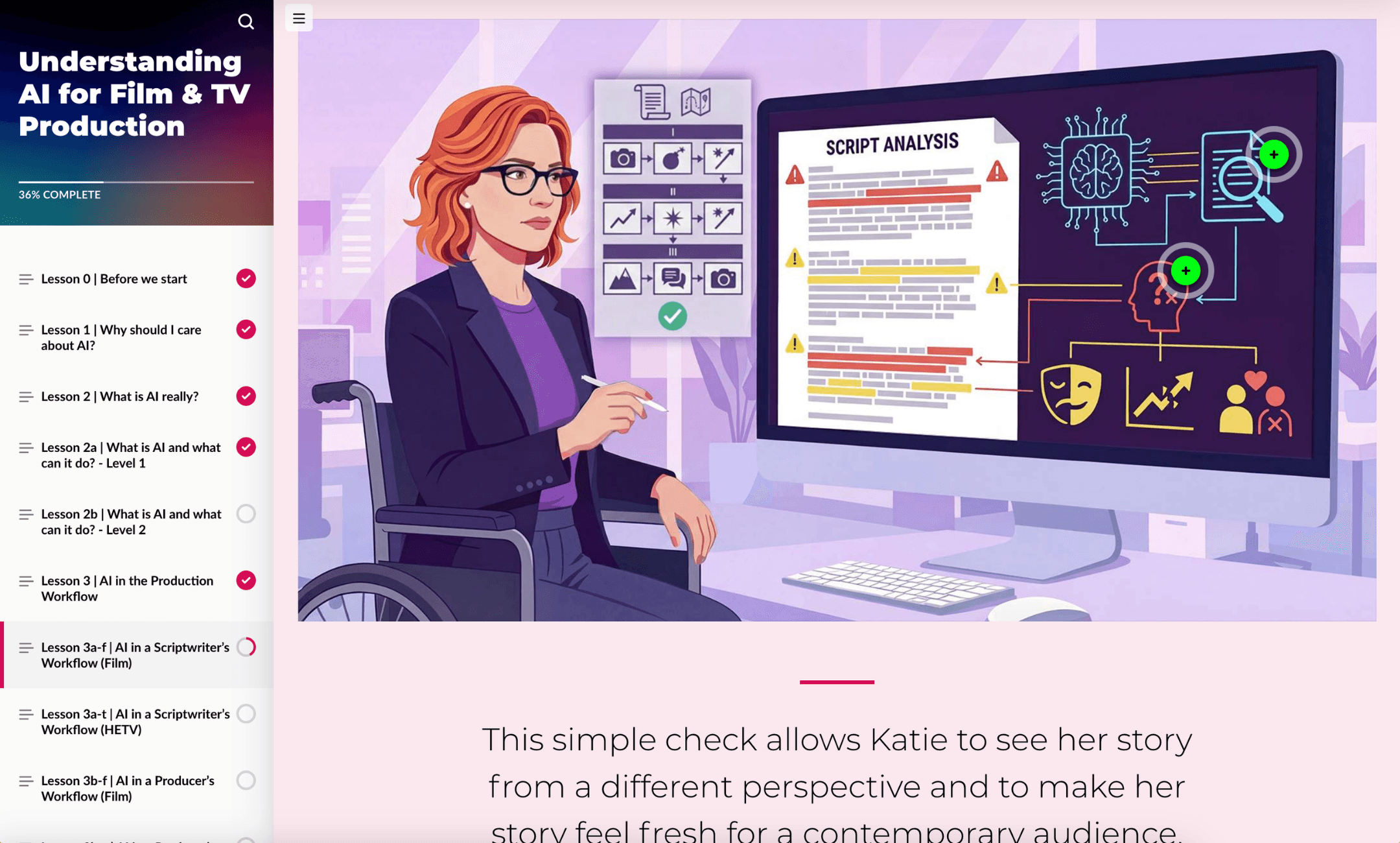
The core objective is to design and develop an interactive module to help industry professionals including producers, screenwriters, and effects technicians understand and adopt a "Responsible Mindset Regarding the Use of Artificial Intelligence (AI)".
The learning experience is designed to be a comfortable and non-threatening introduction to AI. It starts with basic, easy-to-understand tools and gradually builds confidence and competence.
The ultimate goal is not just to teach AI usage, but to foster insights into ethical and responsible AI implementation within the film and television industry.
Problem
The Systemic Challenge
The industry was experiencing severe technical anxiety regarding job replacement, copyright infringement, and performers' rights. The original AIMICI (Artificial Intelligence in Media & Creative Industries) eLearning curriculum was designed to address this, but it fundamentally missed the mark.
Institutional Complexity & "Red Flags"
During the rigorous ScreenSkills accreditation process, the original curriculum received severe "red flags." The core issues included:
Elitism over Inclusion: The content heavily favoured senior roles (Producers, VFX Supervisors, Scriptwriters) and Film-centric pipelines, alienating junior grades, non-scripted sectors, and the broader workforce.
Passive Architecture: It suffered from inconsistent Learning Outcomes (LOs) and a lack of active, scenario-based learning.
Process
Design Process
To rescue the accreditation and truly serve the industry, I have worked as "AI Learning Experience Design Consultant" and gave a complete strategic structural remediation rooted in Learning Experience Design (LXD) Framework including:
Instructional Design: Determining Course Content
Digital Design: Crafting the Look & Feel
eLearning Development: Making Interactions
Working closely with the Founder & CEO of AIMICI and industry Subject Matter Experts (SMEs), I spearheaded the development of a structured curriculum remediation, ensuring that all pedagogical elements met both industry standards and accreditation requirements.
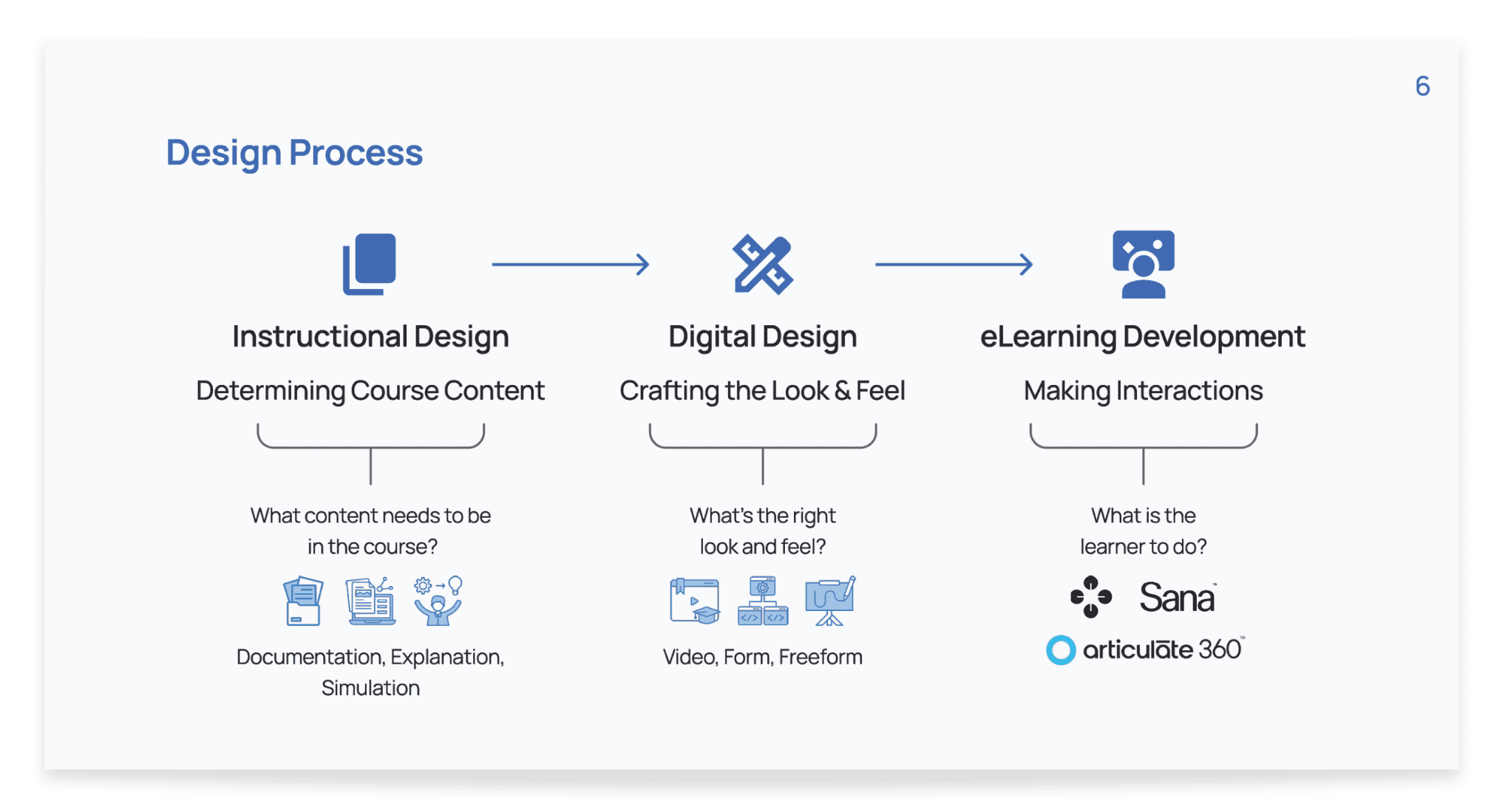
Visual | End-to-End Design Process: Instructional Design + Digital Design + eLearning Development
Instructional Design
My role was to translate AIMICI’s subject-matter expertise into a measurable, accreditation-aligned, cognitively progressive learning system.
Content Writing Strategy
Based on the provided AIMICI lesson content, I developed structured narrative scripts for each module in alignment with:
AIMICI Content Writing Guidelines
Innovate UK Bridge AI Learning Design Accreditation Criteria
Rather than simply editing content, I:
Re-sequenced concepts for progressive cognitive load management
Embedded signalling and reinforcement techniques
Applied plain-English optimisation without diluting technical accuracy
Designed for neurodiversity-aware readability and accessibility
The objective was to maximise clarity, reduce ambiguity, and ensure that learners from varied professional backgrounds within the Film & TV ecosystem could engage with complex AI concepts confidently.
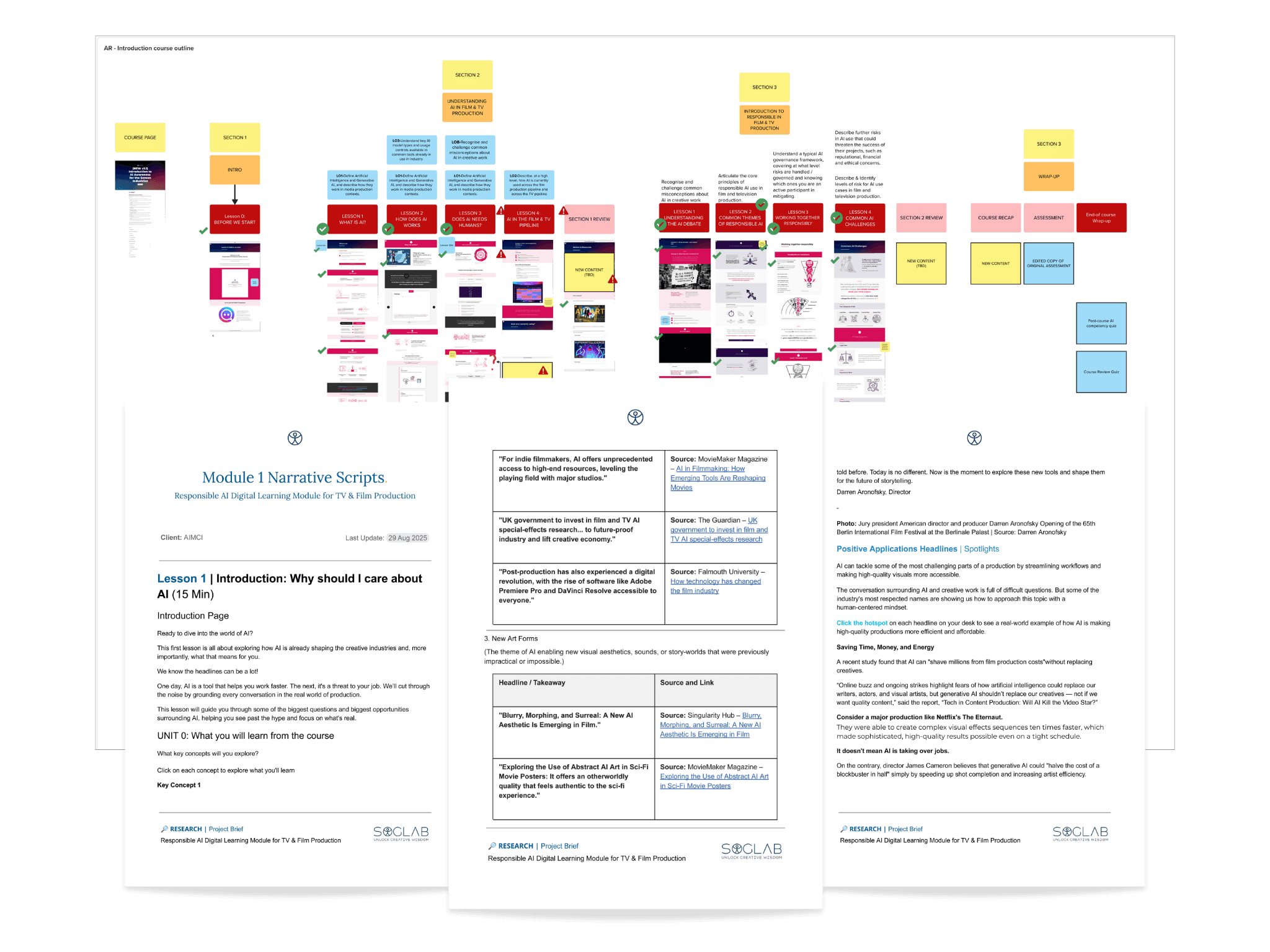
Visual | Content Writing Workflow: Google Docs (Gemini + NotebookLM) & MURAL
Strategic Framework Alignment
Following the release of the UK Government AI Skills Framework (October 2025), I conducted a full curriculum audit and strategic remapping exercise.
This required:
Cross-referencing all modules against updated national AI capability descriptors
Identifying gaps between existing learning objectives and new framework competencies
Repositioning modules to reflect applied and workplace-relevant AI literacy
The redesign elevated the programme from passive knowledge acquisition to performance-oriented capability development. The emphasis shifted from “What is AI?” to “How do I critically evaluate and responsibly implement AI within my professional context?”
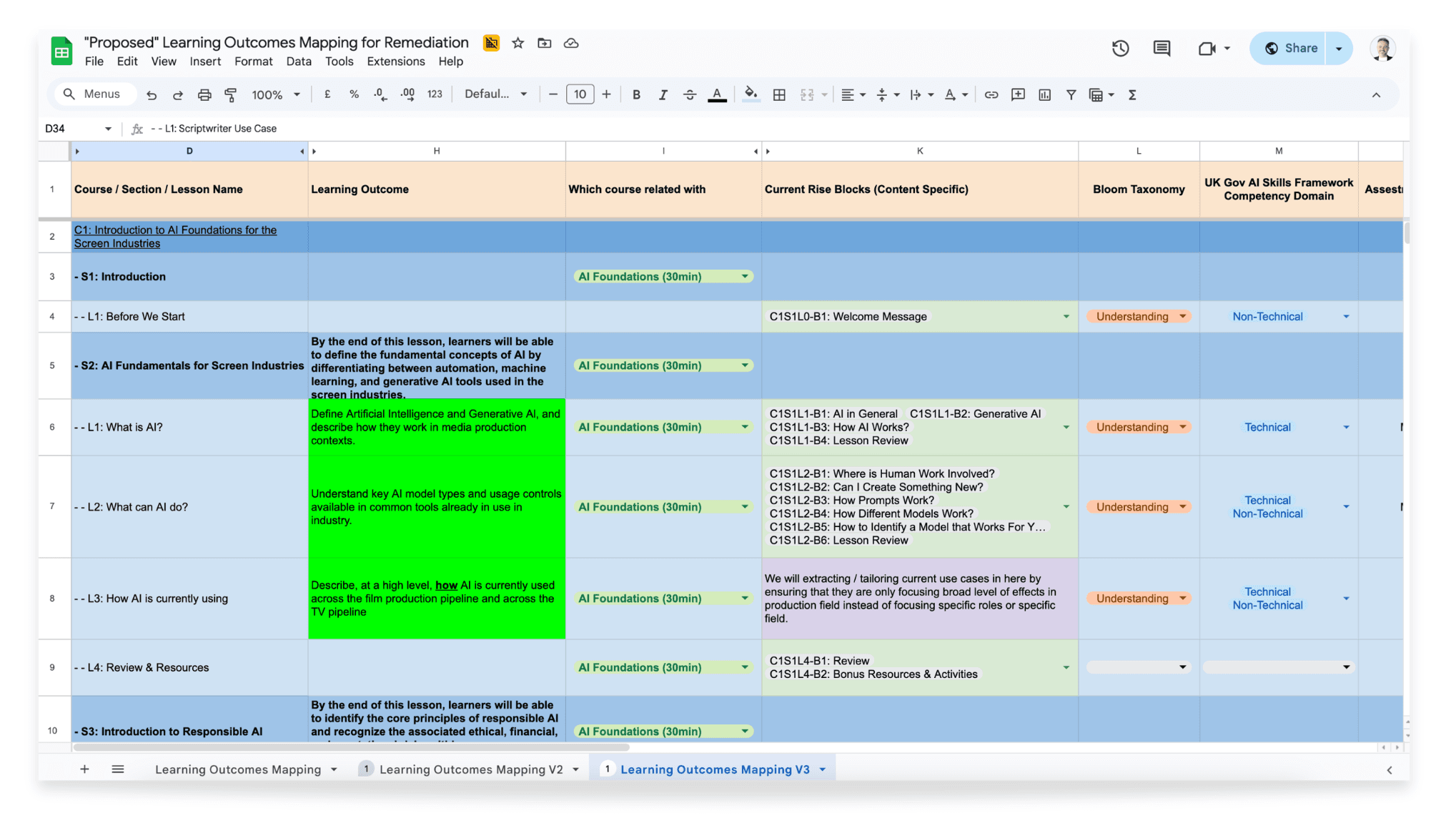
Visual | Learning Outcomes Mapping: Alignment between LOs + Contents + UK Government AI Skills
Learning Outcomes Architecture & Cognitive Progression
I rewrote and tiered the Learning Outcomes using Bloom’s Taxonomy as a structural backbone.
The progression was intentionally differentiated:
Introduction Course: From remembering and understanding foundational AI concepts
Advanced Course: Toward analysing, evaluating, and creating AI-informed solutions
This cognitive elevation ensured vertical alignment between course levels and avoided redundancy between beginner and advanced tracks.
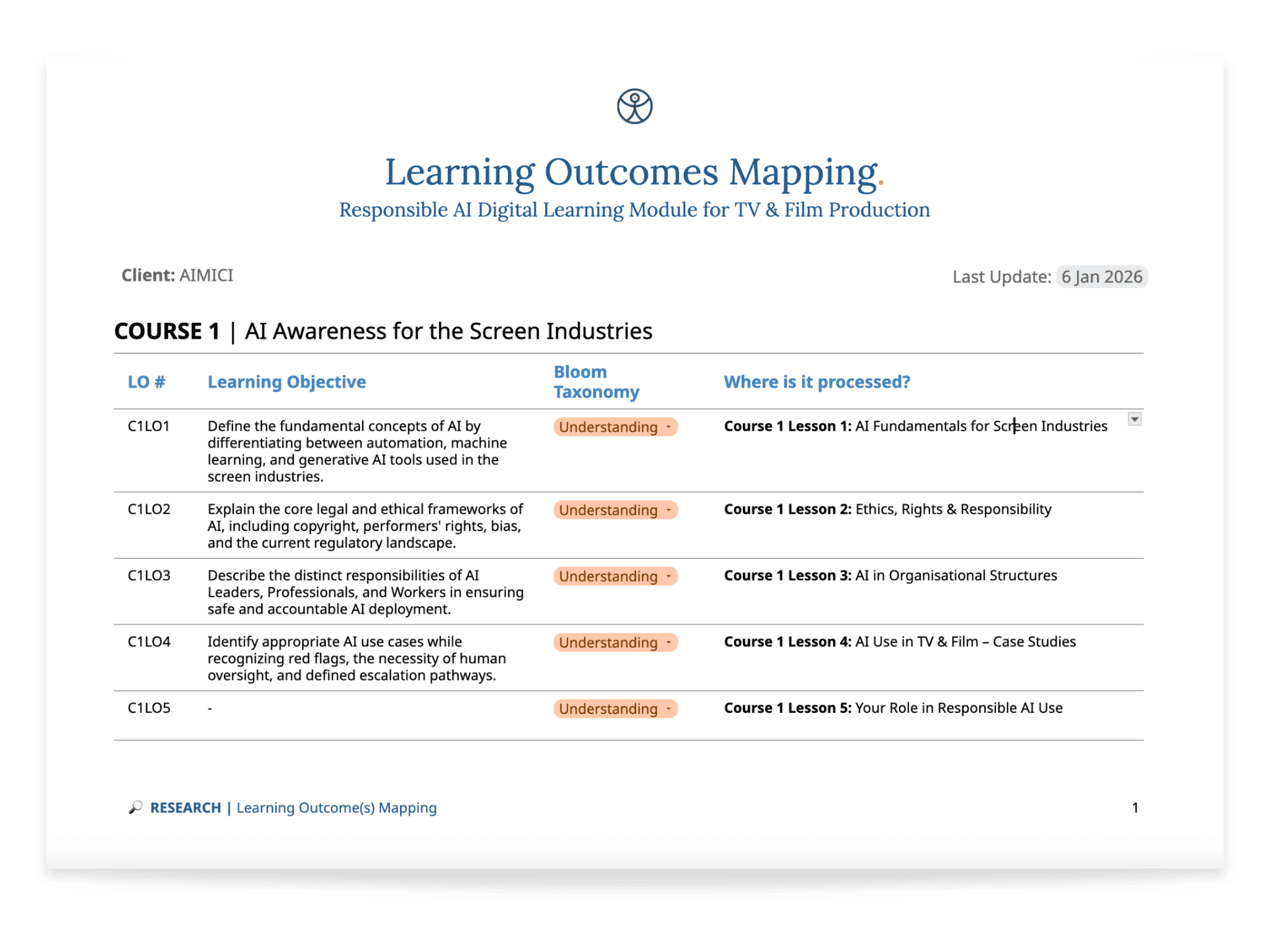
Visual | Learning Objectives Mapping through Blooms Taxonomy
Constructive Alignment & Platform-Level Mapping
A key design priority was maintaining constructive alignment across all levels of the learning ecosystem.
I ensured:
Lesson-Level Learning Outcomes aligned directly with Articulate Rise content blocks and micro-interactions
Section-Level Learning Outcomes mapped to knowledge checks and scenario-based interactive elements
Course-Level Learning Outcomes measured through cumulative quizzes and applied assessments
This structure guaranteed that every interactive element had an explicit pedagogical function, rather than serving as superficial engagement.
The result was:
Transparent performance expectations for learners
Measurable competency progression
Accreditation-ready documentation
A defensible assessment architecture
Digital Design
As a senior Learning Experience Designer, I approached digital design not as a production task, but as a strategic layer of the learning architecture. Every visual asset was developed to reinforce cognitive clarity, brand coherence, accessibility, and instructional intent.
Visual System & AI-Driven Asset Production
I designed and produced all characters, illustrations, and iconography through an iterative AI-supported workflow grounded in advanced prompt engineering. Rather than generating isolated visuals, I built a controlled visual system aligned with the AIMICI Learning HUB Look & Feel framework.
Each iteration was evaluated against:
Visual language consistency
Colour palette integrity
Accessibility and contrast standards
Cross-module scalability
Cognitive load principles
This ensured that all assets functioned as instructional tools — not decorative elements — and maintained strict alignment with the defined brand and UX ecosystem.
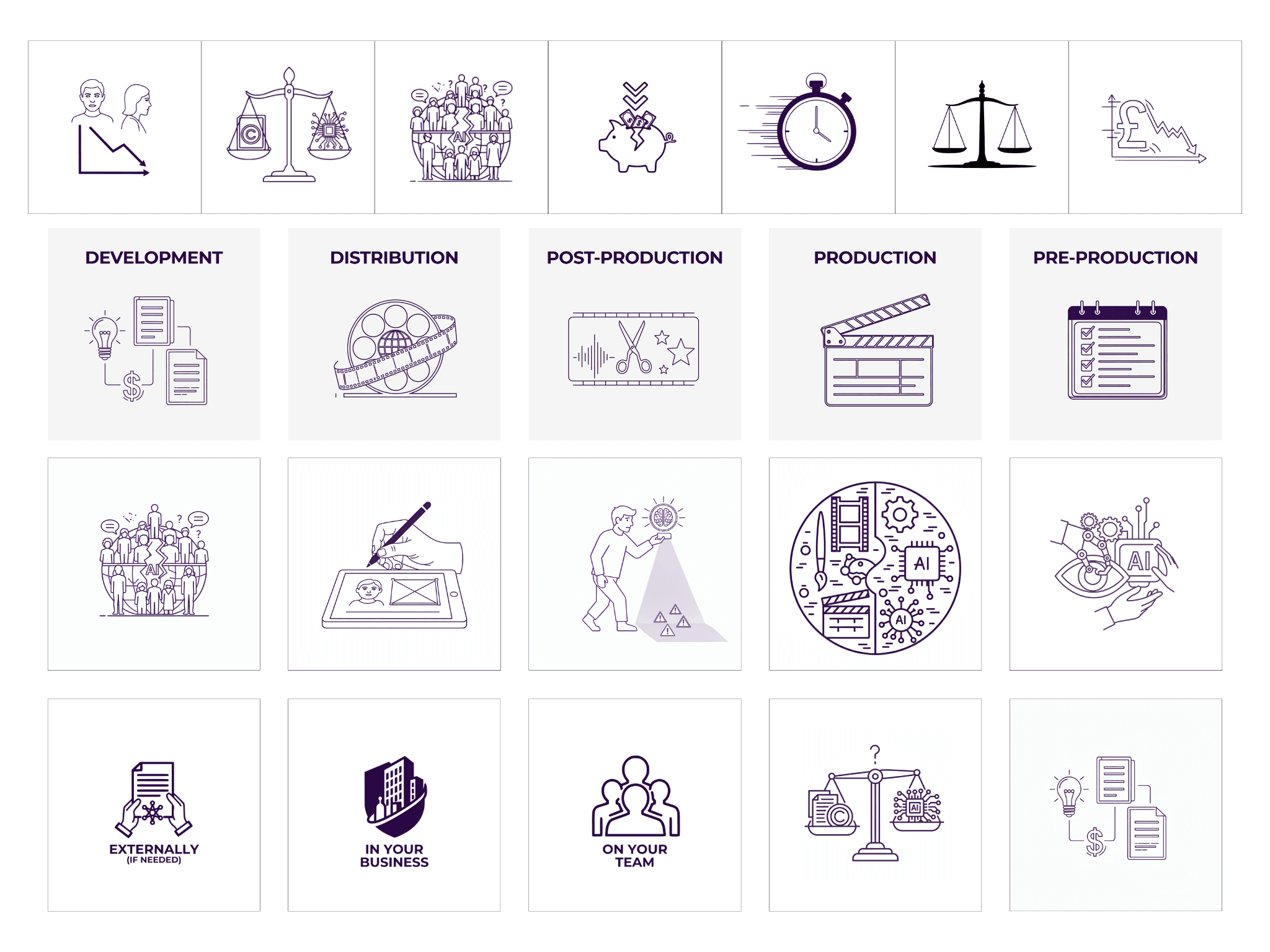
Visual | Icon Design Workflow: Branding Analysis + Prompt Development + Iterative Production with AI
Character Design Strategy
Drawing on my experience as a Google Data Center Community AI Fellow, I developed an inclusive character system representing key roles within the Film & TV Production ecosystem.
Character design decisions were mapped against:
AIMICI Brand Guidelines
Innovate UK Bridge AI Learning Design Accreditation Criteria
ScreenSkills competency frameworks
The goal was not simply representational diversity, but role-based authenticity. Each character was designed to:
Reflect industry-recognizable functions
Support scenario-based learning
Increase learner identification and engagement
Reinforce professional realism
All assets were developed using Google Labs tools with structured high-fidelity prompting to ensure stylistic and narrative consistency across modules.
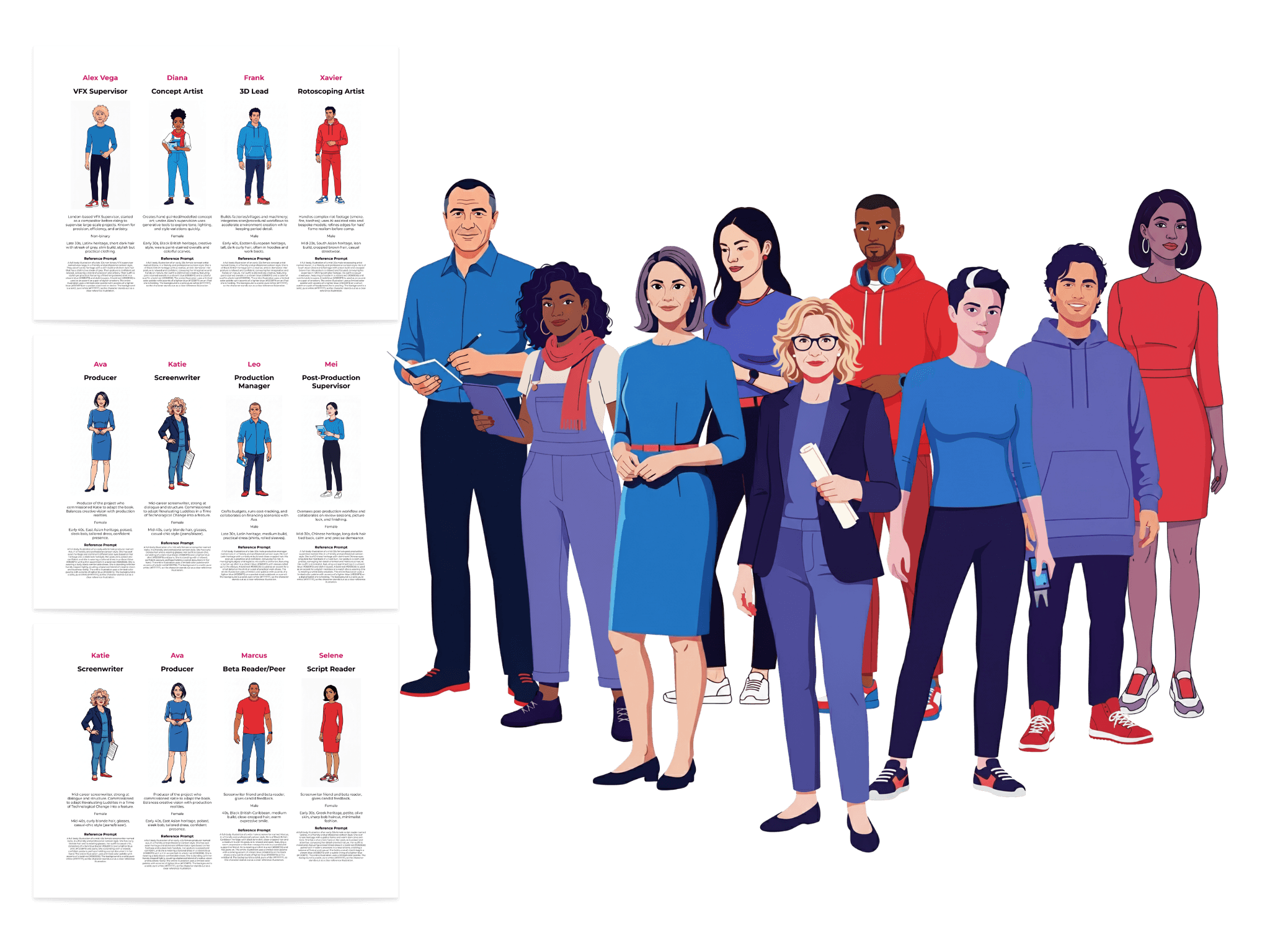
Visual | Character Design Workflow: Persona Development + Prompt Development + Iterative Production with AI
Process Illustrations & Production Cycle Visualisation
To support systems thinking and procedural clarity, I designed visual scenes covering the full Film & TV production lifecycle:
Development
Pre-Production
Production
Post-Production
Distribution
These illustrations were intentionally structured to:
Visualize workflow dependencies
Clarify stakeholder roles
Reduce ambiguity in complex processes
Support scaffolded learning progression
In parallel, I developed a cohesive icon set aligned with AIMICI’s brand system. Icons were designed for rapid cognitive recognition, UI clarity, and cross-platform usability.
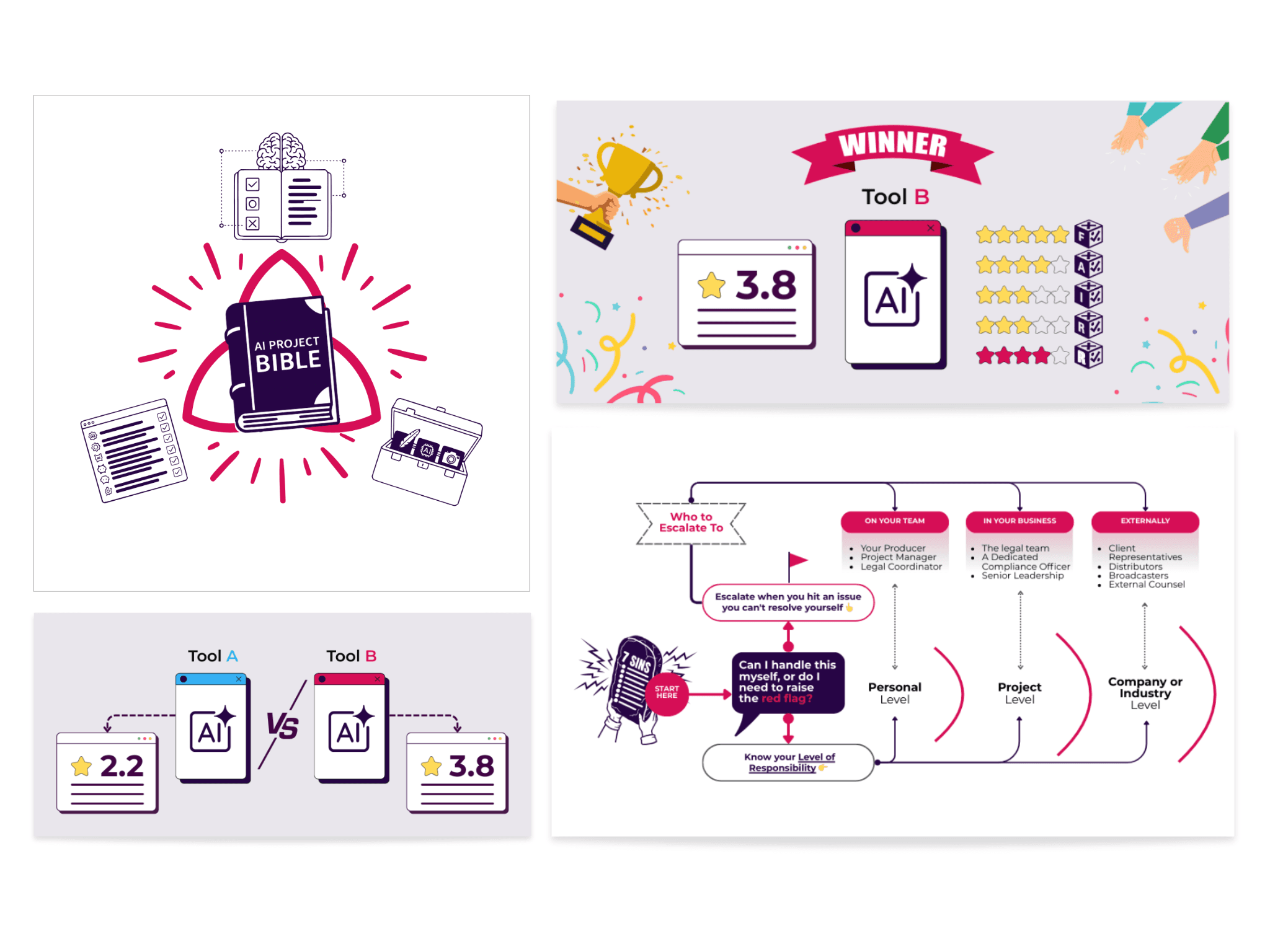
Visual | Process Illustration Design Workflow: Content Analysis + Prompt Development + Manual Re-Production
Explanatory Video Design
For selected eLearning sections, I transformed industry constraints, assumptions, fears, and aspirational drivers into short-form explanatory videos.
This process included:
Narrative scripting grounded in learner personas
Tone calibration for UK professional standards
AI-supported voice production using ElevenLabs
Post-production editing in Adobe Premiere Pro and Camtasia
Rather than focusing solely on information delivery, these videos were designed to:
Normalize industry challenges
Address emotional barriers to AI adoption
Build psychological safety
Frame AI as an augmentation tool rather than a threat
All voiceovers and narrative structures were reviewed to ensure cultural and professional alignment with UK sector expectations.

Visual | An example for explanatory video
eLearning Development
The development phase translated the instructional architecture and visual system into a scalable, accessible, and accreditation-ready digital learning environment.
All visual assets were systematically converted into educational videos, interactive blocks, and multimodal learning components using:
Articulate Rise (primary authoring environment)
Articulate Storyline (advanced interaction scenarios)
Adobe Premiere Pro (video post-production)
Camtasia (screen-based demonstrations and edits)
The development workflow prioritised consistency, accessibility, production efficiency, and rapid iteration cycles.
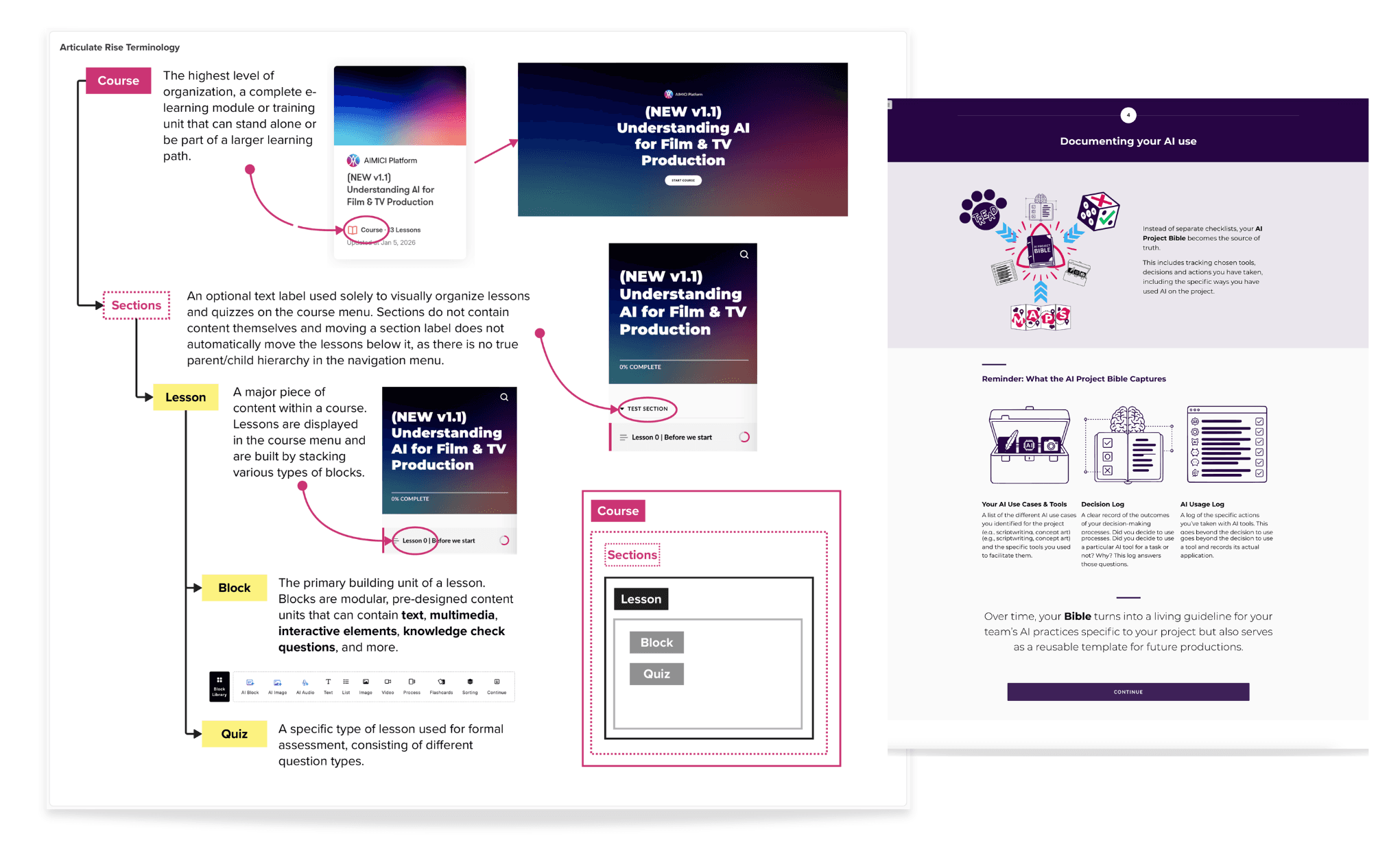
Visual | Articulate Storyline Taxonomy Strategy: Course > Sections > Lessons > Blocks
Authoring Tool Decision & Delivery Strategy
Considering the limited budget and compressed timeline, I contributed to the critical decision-making process between SanaLearn, Articulate Storyline, and Articulate Rise.
Following a comparative evaluation across:
Development speed
Scalability
Accessibility features
Review and iteration workflow
Accreditation documentation readiness
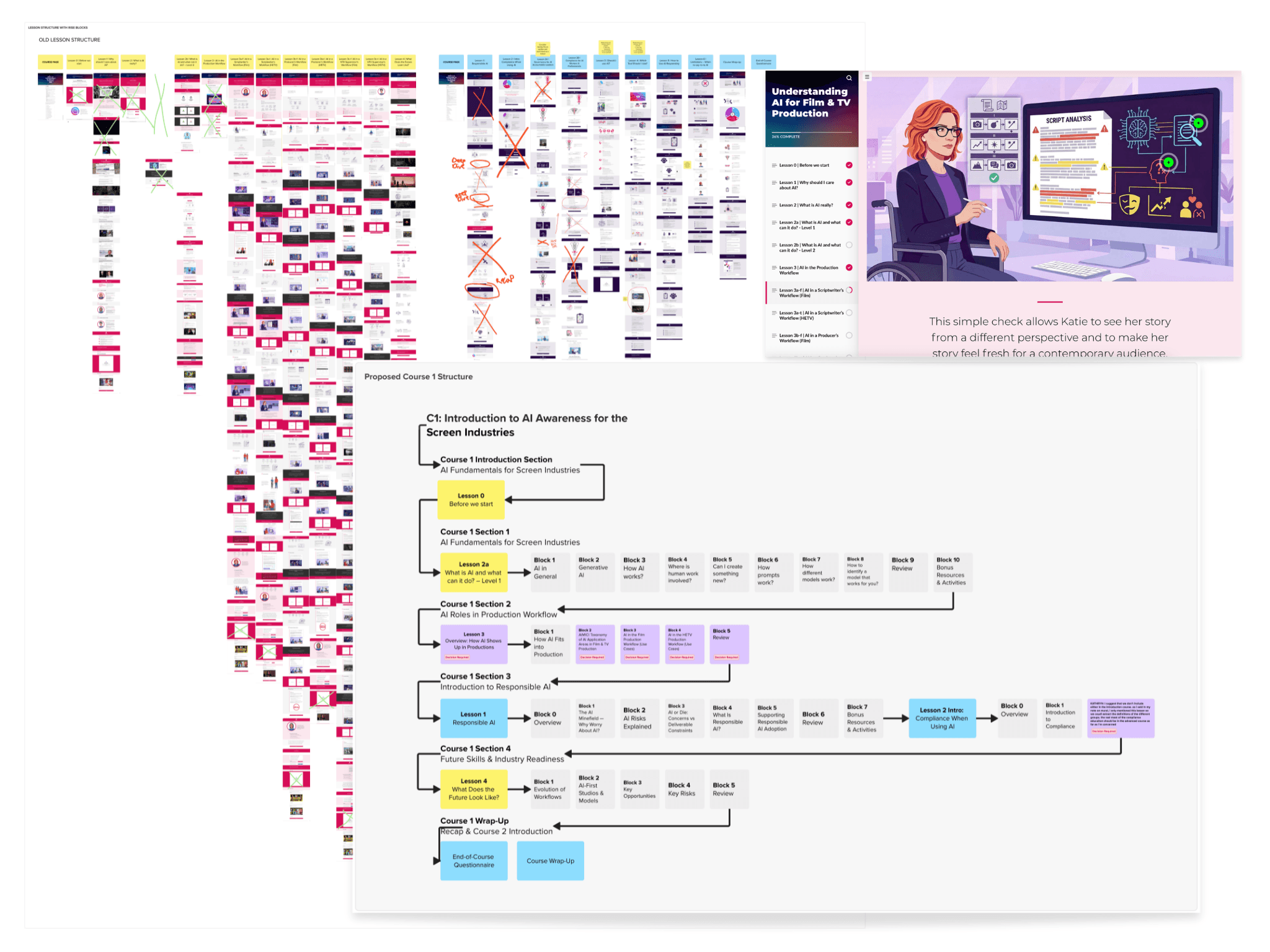
Visual | From Project MURAL: Modules Screenshots and Learner Journey Example
Articulate Rise was selected as the primary authoring tool. This decision enabled the delivery of first-release versions of both the Introduction and Advanced eLearning modules, comprising 20+ lessons, within a one-month production window, ready for the first evaluation cycle.
The choice supported:
Rapid prototyping
Modular scalability
Efficient stakeholder feedback loops
Reduced technical overhead
Accessibility Integration & Compliance
Accessibility was addressed as an integrated production layer rather than a post-production correction. In response to the initial evaluation report provided by ScreenSkills, I worked closely with the team to operationalise all identified Accessibility Requirements across modules.
Enhancements included:
Subtitles for Video Content
Captions for Process-Based GIF Illustrations
Subtitles for Video Content
All original video narrations were transcribed and embedded with synchronised subtitles to support inclusive learning and flexible consumption.
Captions for Process-Based GIF Illustrations
For the animated GIFs illustrating workflows, journeys, and step-by-step instructions, alternative text-based explanations were added adjacent to each visual.
This ensured:
Readability without motion dependency
Compatibility with screen readers
Reduced cognitive strain
Equal access for visually impaired learners
Colour Contrast & Visual Accessibility
When generating AI-assisted visual assets, I used customised prompt parameters to maintain accessible contrast ratios aligned with digital accessibility standards.
Additionally, I leveraged new accessibility features within Articulate Rise to ensure text readability and visual hierarchy integrity across devices.
Competency-Level Based Learning Architecture
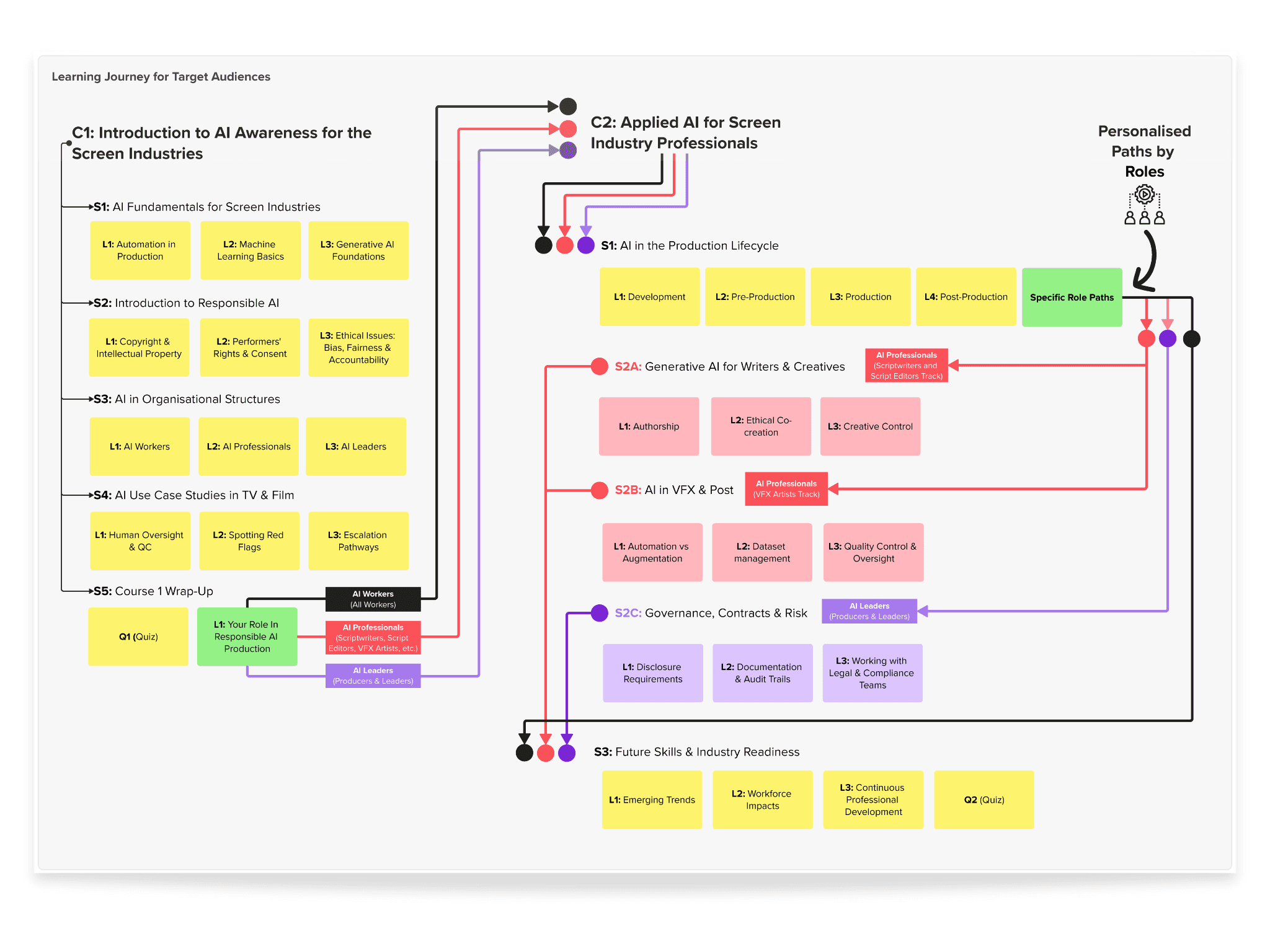
Visual | From Project MURAL: Competency-Related Personalised Learning Pathways
I played an active role in integrating the AI-powered AIMICI Companion into the learning ecosystem.
During the Advanced Module design, particular emphasis was placed on enabling differentiated learning journeys tailored to distinct professional roles within the Film & TV production landscape.
This involved:
Mapping role-specific competencies
Structuring adaptive progression pathways
Aligning AI support interventions with learner proficiency levels
The result was a competency-aware learning journey where professionals from varied backgrounds could navigate the course in ways relevant to their operational realities.
Transparency in AI Use & Ethical Visibility
Throughout the eLearning production lifecycle, I documented the use of AI tools across content creation, visual generation, scripting, and editing stages.
To maintain transparency and responsible AI practice, I adopted the framework developed by the Dubai Future Foundation titled Visual Standards for Research and Publications.
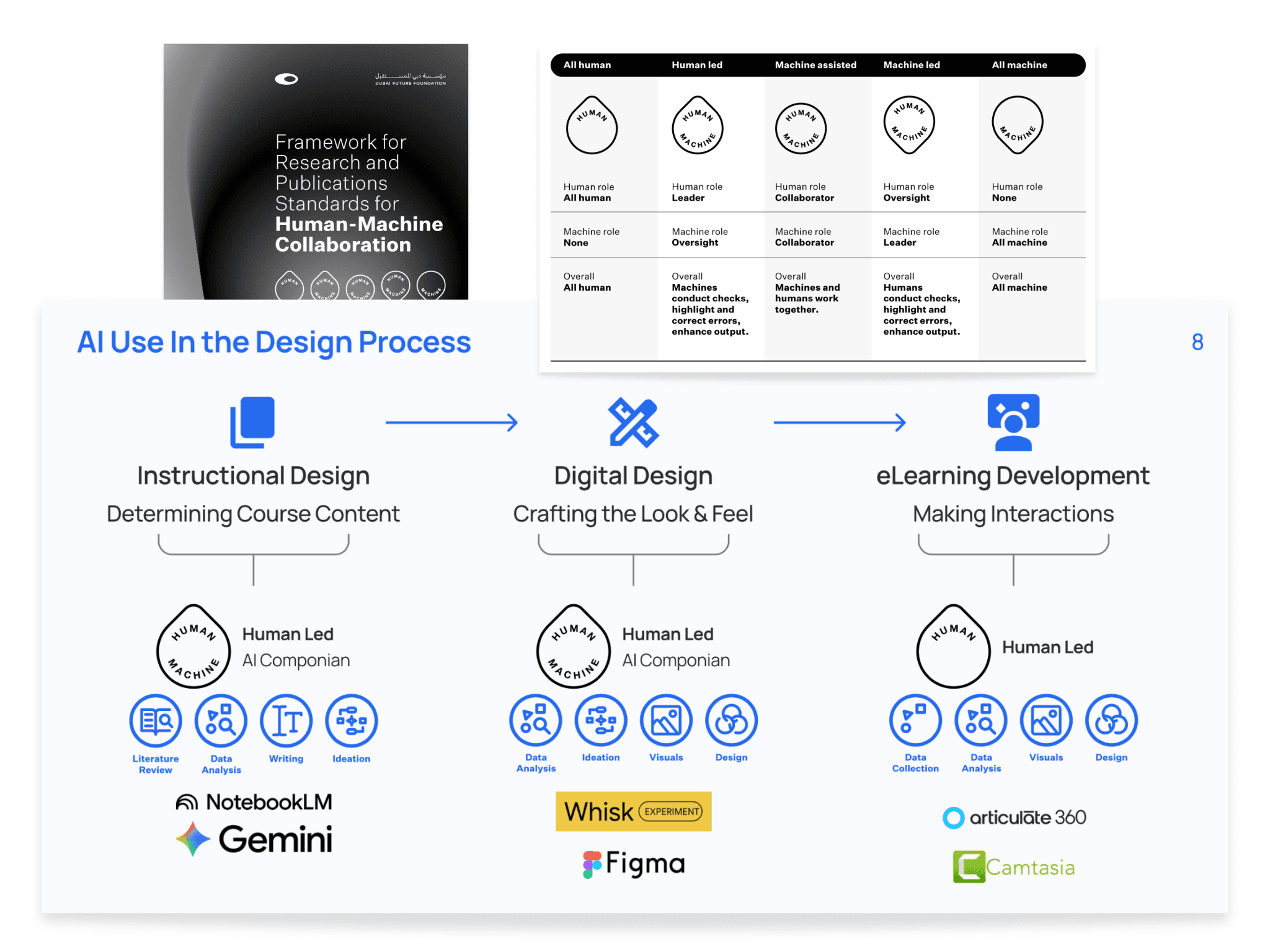
Visual | AI Usage in my Design Workflow through "Human-Machine Collaboration in Research and Publications"
Using their Icons for Human–Machine Collaboration (HMC) system, I made visible:
Where AI contributed to output
Where human editorial oversight intervened
Where final decision authority remained
This approach strengthened:
Ethical design accountability
Stakeholder trust
Accreditation defensibility
Responsible AI modelling for learners
Solutions
Designing an Ethical Learning Architecture for the Screen Industries
The remediation challenge required more than structural edits. It demanded a complete architectural redesign that could simultaneously satisfy accreditation criteria, industry credibility, and workforce anxiety around AI.
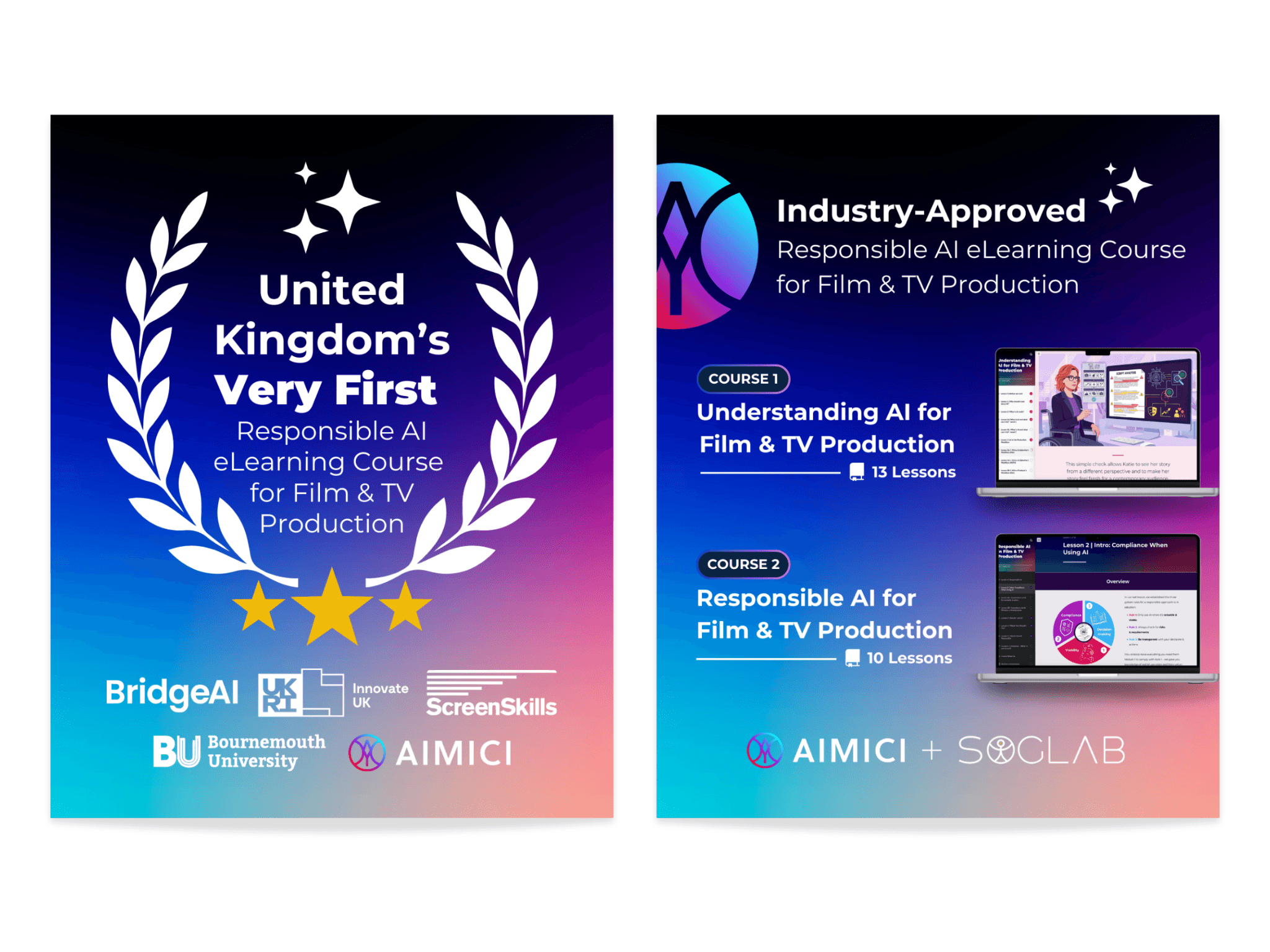
I designed a bifurcated, scalable Learning Experience ecosystem that addressed two parallel needs:
Introduction Course: Establishing a shared AI literacy baseline across the industry
Advance Course: Providing advanced, role-specific governance and risk capability
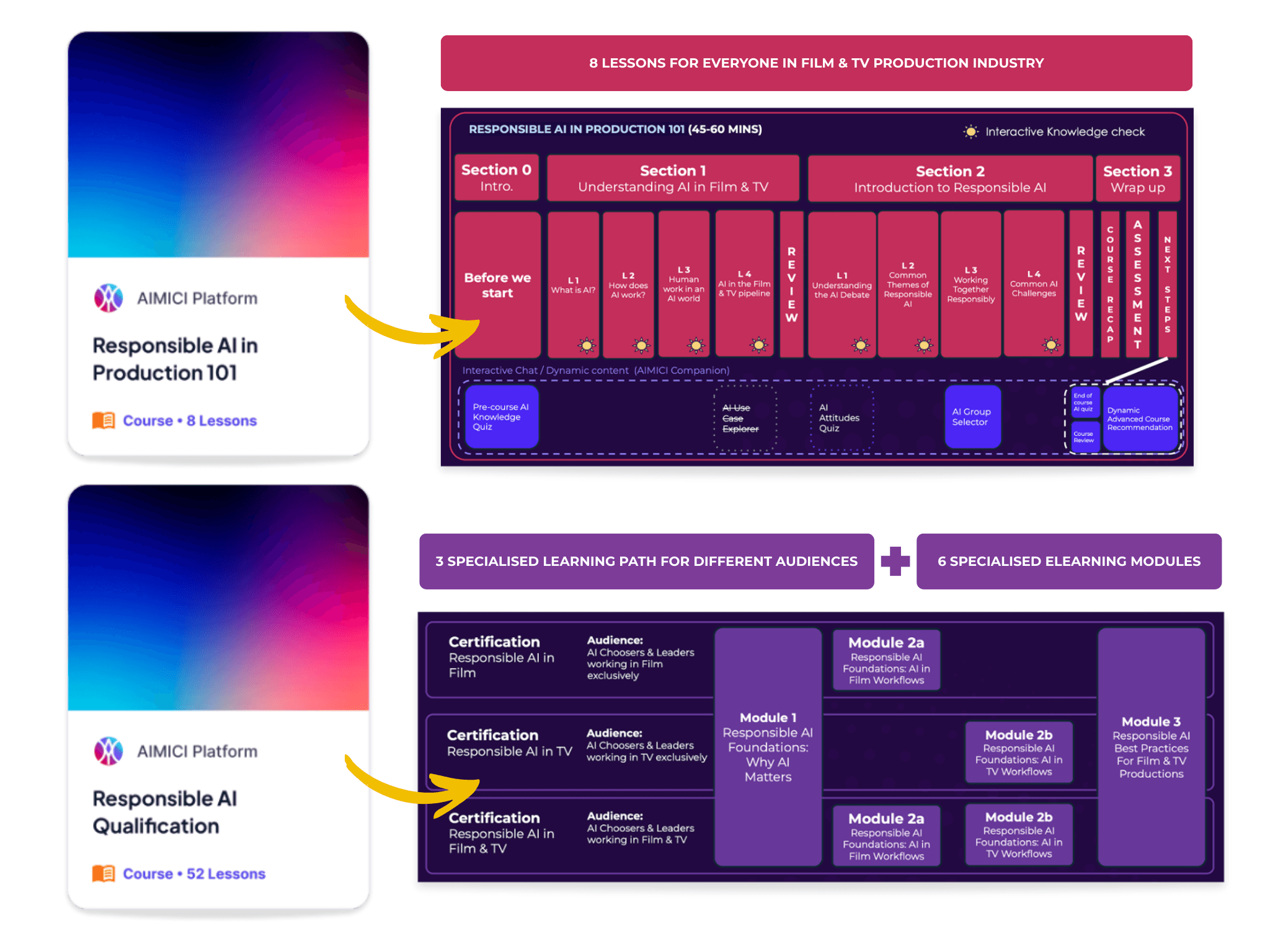
Visual | Learning Pathways for Each Course (Introduction + Advance)
Beyond just an educational tool, the project evolved into an industry-approved benchmark, ultimately achieving official accreditation from ScreenSkills for its responsible approach to AI integration in production.
The Bifurcated Curriculum Model
The final architecture separated the learning journey into two clearly defined, progression-based pathways:
Responsible AI in Production (101) – 60 minutes
Audience: Everyone in the Film & TV Production (AI Users, AI Choosers, AI Leaders)
A role-agnostic foundational module designed to:
Establish a shared vocabulary around AI and Generative AI
Address common misconceptions within creative industries
Introduce governance, legal watch-outs, and risk awareness
Frame AI use within real production workflows
This module created a standardised competency baseline for the workforce.
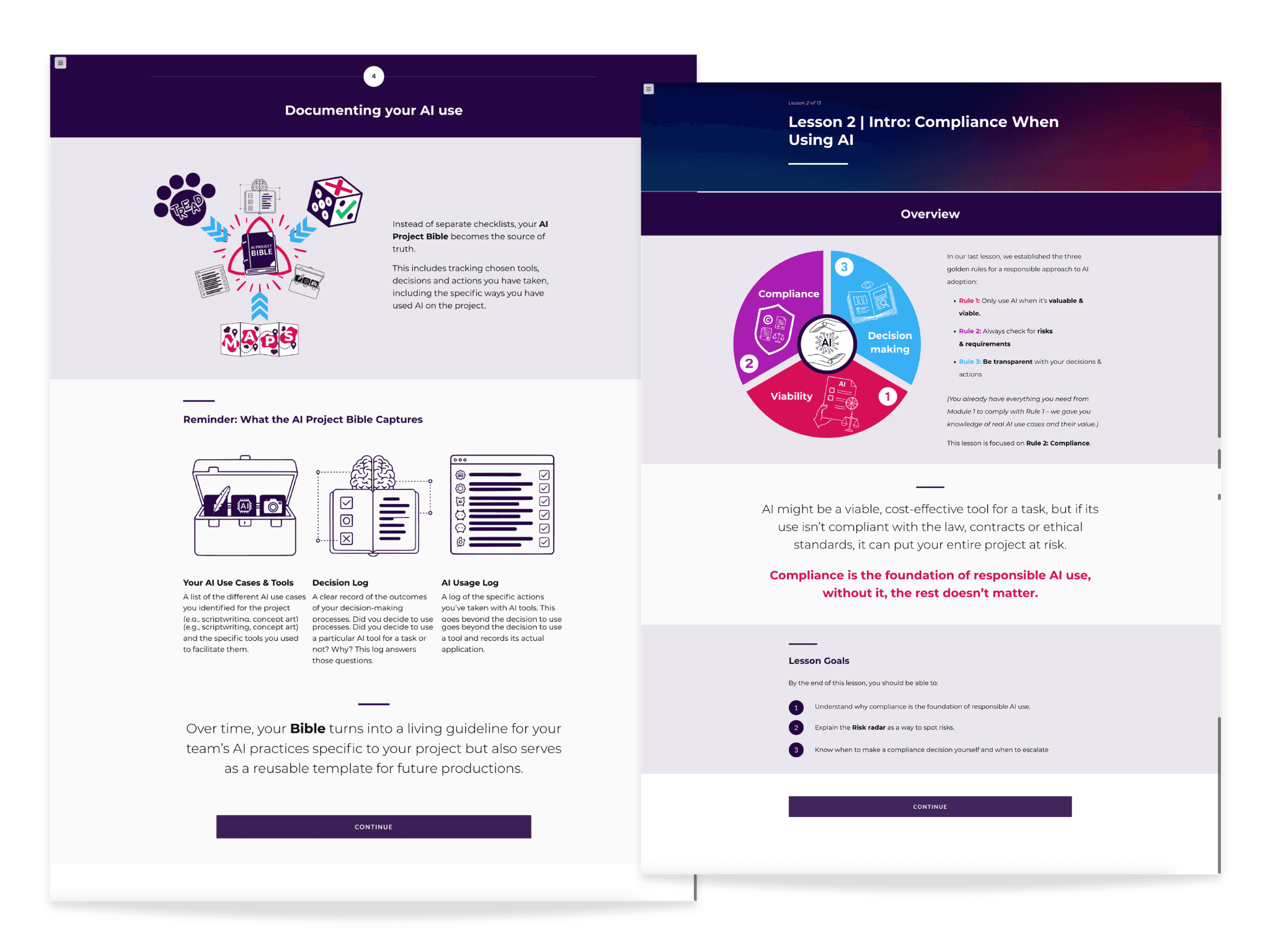
Visual | Lesson Examples from Modules
Responsible AI Qualification (Advanced – 4–5 hours)
Audience: AI Choosers & Approvers in the Film & TV Production
A specialised programme structured across three modules:
Responsible AI Foundations: Why AI Matters
AI in Film Workflows / AI in HETV Workflows (branched pathways)
Responsible AI Best Practices
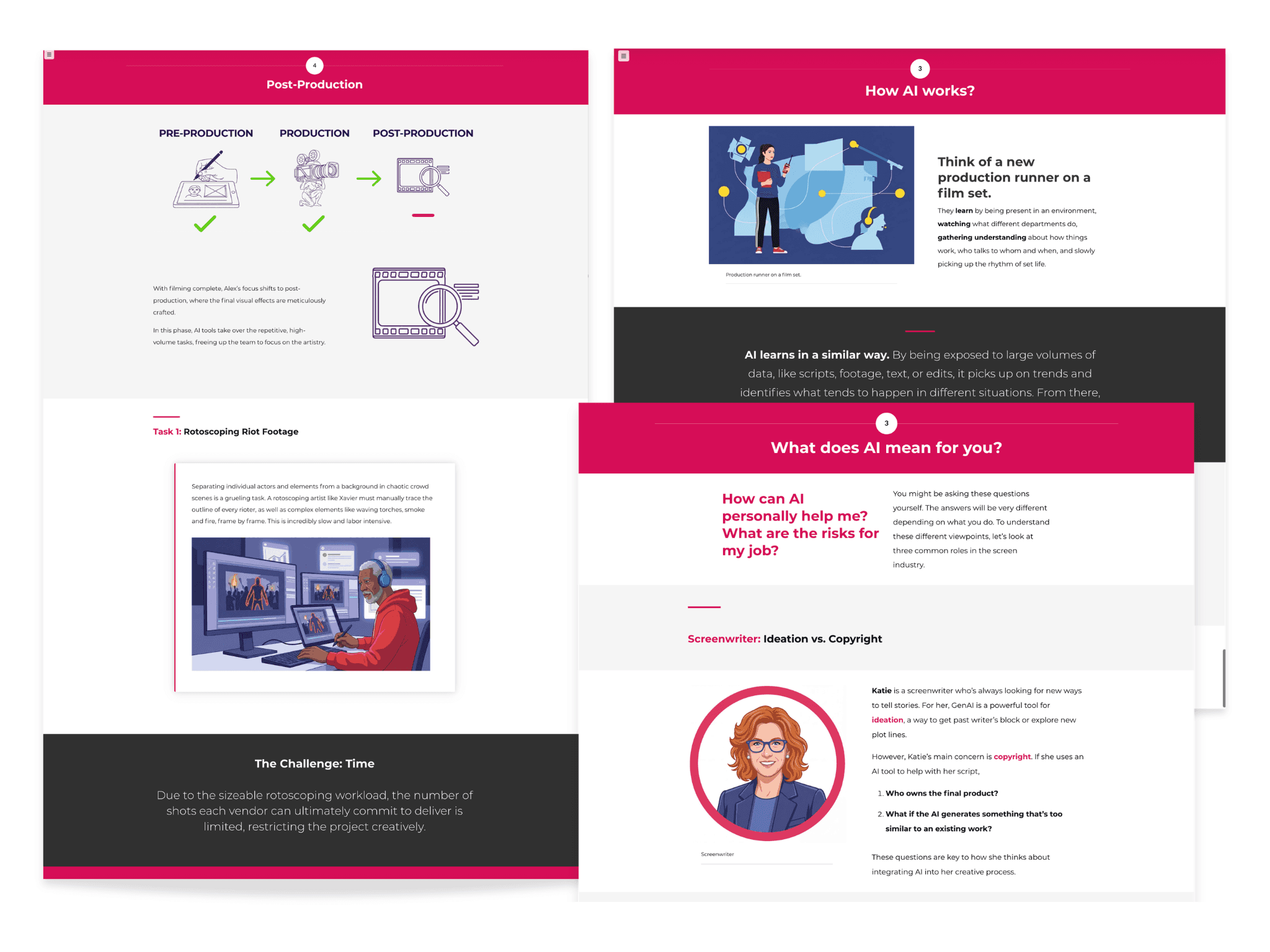
Visual | Lesson Examples from Modules
The branched structure allowed learners to select Film or High-End TV (HETV) contexts, ensuring role authenticity and industry specificity, as documented in the advanced course maps.
Within these modules, Scriptwriters, Producers, and VFX Supervisors engaged with:
Workflow-specific AI use cases
Risk simulations
Tool selection frameworks (MAPS, FAIRR)
Governance and documentation practices
Decision-making simulations
This design ensured contextual credibility while maintaining structural consistency.
Results
Scaling AI Competency Across the UK Screen Industries
In close collaboration with the AIMICI core team and key Subject Matter Experts (SMEs), I transitioned this project from a state of institutional rejection to a benchmark-setting framework for the UK screen sector. By rebuilding the curriculum's architecture alongside these specialists, I secured a pathway for ScreenSkills accreditation and established a defensible standard for responsible AI adoption.
1. Architectural Recovery & Collaborative Remediation
Working as a strategic bridge between the AIMICI team and industry SMEs, I led the full-scale remediation of the red-flagged curriculum. This collective effort focused on aligning the program with industry governance requirements and the UK Government AI Skills Framework.
Outcome-Driven Remapping: Collaborating with the AIMICI team, I overhauled the learning outcomes to ensure measurable skill acquisition, moving beyond conceptual awareness to practical application.
Inclusive Design: We introduced role-specific tagging and pathways, making the training relevant for both senior leadership and junior-level roles across scripted and non-scripted sectors.
Structural Optimization: I led the technical implementation of a simplified content hierarchy, replacing passive modules with high-impact, active learning sequences.
2. Quantitative Success Metrics
The data from the pilot phases—validated by the AIMICI team—confirms the effectiveness of our collaborative design in driving knowledge transfer.
Foundational Course (Responsible AI 101)
Assessment Performance: Learners achieved an average quiz score of 3.6 / 4.1.
Proficiency: 73% of the participants reached a perfect score on their first attempt.
Engagement: The program maintained a relevance rating of 4.0–4.5 / 5 with an NPS of 7.33.
Advanced Qualification
Mastery: Objective mastery rates reached between 67% and 100% across specialized modules.
Role Alignment: Relevance to specific professional roles reached 4.24 / 5, resulting in a high NPS of 8 / 10.
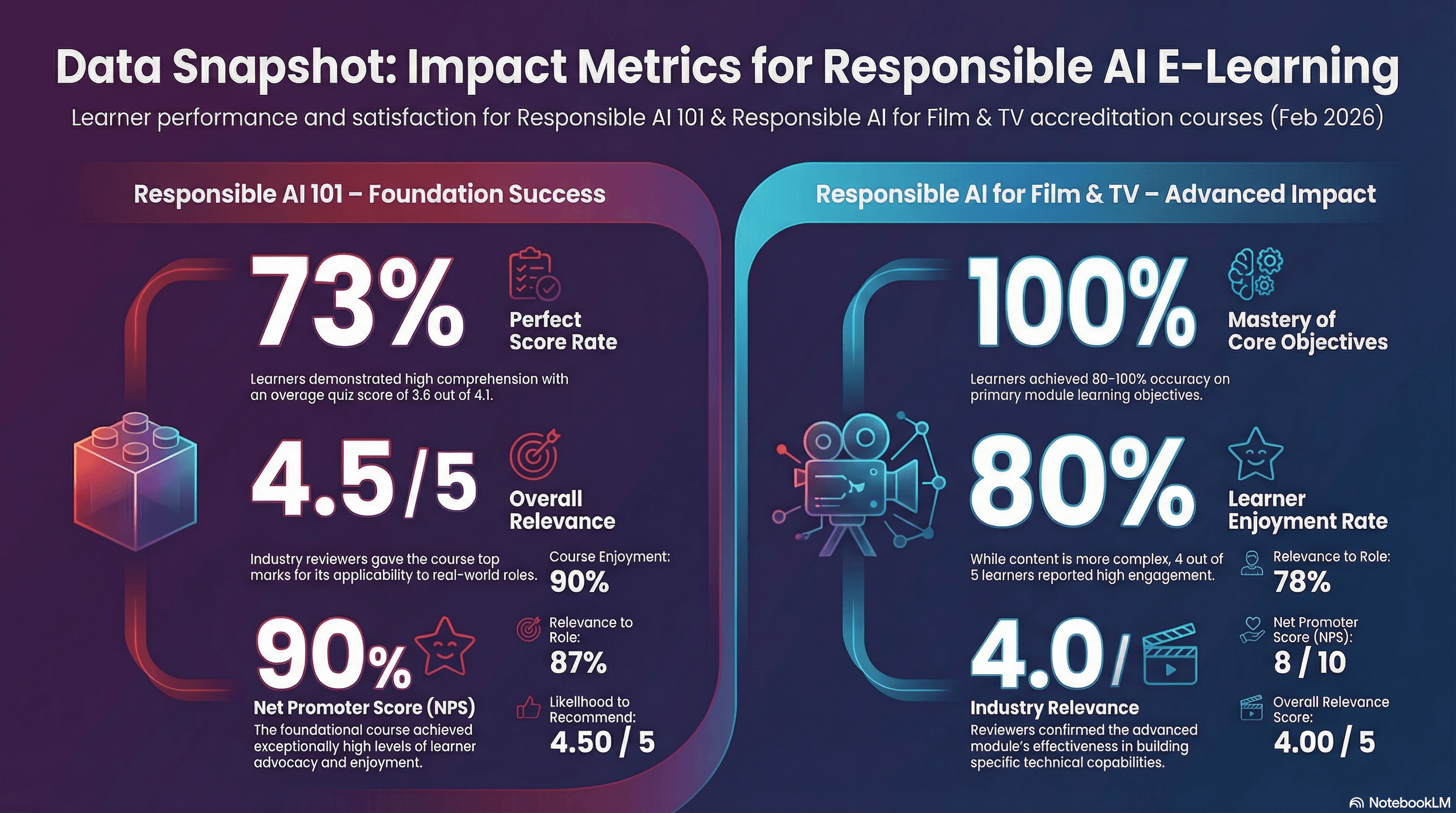
Infographic | Testing Results for Both Modules
3. Workforce & Strategic Outcomes
I designed this UK’s Very First Responsible AI eLearning Modules for TV & Film Production to support the 200,000+ professionals in the UK screen workforce, leveraging SME insights to address the specific needs of the 50% freelance community.
Standardization: Together with the AIMICI team, we authored the first unified AI competency baseline applicable across the industry.
Risk Mitigation: I integrated expert SME guidance to provide freelancers with the governance literacy required to protect their intellectual property and creative rights.
Institutional Trust: This collaborative redesign enabled producers and leaders to implement AI workflows with clear audit trails and defensible decision-making protocols.
Narrative Shift: We repositioned the AI conversation around accountability and professional agency, directly addressing industry-wide displacement anxieties through applied learning.
4. Industry Recognition & Accreditation
The course has been officially Accredited by ScreenSkills, the UK’s industry-led skills body. This accreditation confirms that the training meets the highest professional standards for the screen industries, ensuring the curriculum is both rigorous and industry-approved.
Final Reflection
In this project, I operated at the intersection of instructional design, SME expertise, and organizational governance. I treated the curriculum as a scalable learning ecosystem that builds cognitive resilience against technological disruption.
My role as a AI Learning Experience Design Consultant involved coordinating with the AIMICI and SME teams to translate complex risks into professional standards. We prioritized ethical scaffolding and risk literacy, ensuring that the training functioned as a professional capability accelerator.
The final solution restored institutional confidence and provided the screen industries with a robust, compliant framework for the future of work.